
Most families face this question somewhere around Year 9 or 10, when schools start asking students to choose a path. The options look straightforward on paper — A-Levels or the International Baccalaureate — but the implications stretch further than most people realise when they first sign the form.
UK universities accept both. That much is clear. What is less clear is whether both qualifications are viewed equally, whether one genuinely prepares students better for certain degrees, and — the question parents actually want answered — which one gives their child the better shot at Oxford, Cambridge, or a top medical school.
This guide works through all of it. No universal answer, because there isn’t one. But by the end, the right choice for your child should be considerably clearer.

What Are A-Levels and How Do They Work?
A-Levels — Advanced Levels — are the standard pre-university qualification in England, Wales, and Northern Ireland. Most students take three subjects, occasionally four, over two years (Years 12 and 13). You pick your subjects at 16, study them in depth, and sit final exams at 18. That’s broadly it.
The depth is the point. Three subjects means three subjects taken seriously — not surveyed, not sampled, but genuinely studied at a level that begins to approach first-year undergraduate work. A student doing Chemistry, Biology, and Mathematics is spending essentially all of their academic time on those three things. By the end of two years, they know them well.
Structure and Subjects
Most A-Level students choose subjects that connect to their intended university course. A medicine applicant will take Chemistry plus at least one of Biology, Mathematics, or Physics. A law applicant might take History, English, and Politics. There is no compulsory core — no mandatory language, no required breadth outside your chosen subjects.
This is by design. A-Levels are a depth qualification. The system assumes you already know what direction you are heading, or at least what area interests you most.
Grading System
A-Levels are graded A*, A, B, C, D, E, and U (ungraded). University offers are made in terms of these grades — typically expressed as AAA, A*AA, or A*A*A for the most competitive courses. Oxford medicine requires A*AA minimum. Cambridge asks for A*A*A. Imperial sits at AAA, though successful applicants usually exceed this.
Grades are based almost entirely on final exams. There is some coursework in certain subjects, but the weight sits firmly on terminal assessment. For students who perform well under exam pressure, this works in their favour. For those who don’t, it is a genuine risk.
Who Typically Takes A-Levels
A-Levels are the default for students educated in the UK state or independent school system. International students at British international schools abroad also frequently take A-Levels. If your child is at a school that offers both A-Levels and IB, the choice is real. If they are at a school that only offers one, the decision has already been made for you.
What Is the IB Diploma and How Does It Work?
The International Baccalaureate Diploma Programme is a two-year qualification taken between ages 16 and 19, offered by schools in over 160 countries. It was designed specifically for internationally mobile students — families who move between countries and need a qualification that travels with them. That origin explains a lot about what the IB is and why it looks the way it does.
Where A-Levels ask students to go deep into three subjects, the IB asks them to go reasonably far into six. It is a breadth qualification at heart — built on the idea that an educated person should have meaningful engagement with languages, sciences, humanities, and mathematics before they specialise at university.
Structure and Core Components
IB students take six subjects across six groups: Studies in Language and Literature, Language Acquisition, Individuals and Societies, Sciences, Mathematics, and the Arts. Three subjects are taken at Higher Level (HL), three at Standard Level (SL). Higher Level is where the real academic weight sits — HL Chemistry or HL Mathematics is genuinely demanding work.
Beyond the six subjects, the IB has three compulsory core components that A-Levels do not: Theory of Knowledge (TOK), an interdisciplinary philosophy course examining how we know what we know; the Extended Essay, a 4,000-word independent research paper; and CAS — Creativity, Activity, Service — a structured programme of extracurricular engagement. These are not optional extras. They are part of the diploma, and students cannot graduate without completing them.
Grading System
Each subject is graded from 1 to 7. The maximum score from six subjects is 42, with up to 3 bonus points available from the core components, giving a maximum total of 45. Most competitive UK university offers for IB students are expressed in terms of total points and specific HL grades — typically 38–40 points overall, with 6s or 7s in relevant Higher Level subjects.
For context: a score of 40 or above puts a student in roughly the top 5% of IB candidates globally. The average score worldwide sits around 30–31. The bar for competitive UK university admission is high.
Who Typically Takes the IB
The IB is most common at international schools — the kind attended by children of diplomats, executives, and internationally mobile families. It is also offered at a growing number of independent schools in the UK, and at some state schools with sixth form centres. For students in Brazil, Argentina, the UAE, or elsewhere in the international school system, the IB is often the default, not the exception.
This matters. If your child is already in an IB school, switching to A-Levels may not be a realistic option. The question then shifts from “which is better?” to “how do we make the strongest possible IB application?”
How UK Universities View A-Levels vs IB
Both qualifications are accepted by every major UK university. Neither is formally preferred over the other — at least, that is what admissions offices say publicly. The reality is more nuanced, and it varies by institution, by subject, and by what the admissions tutor is actually looking for when they read your child’s application.
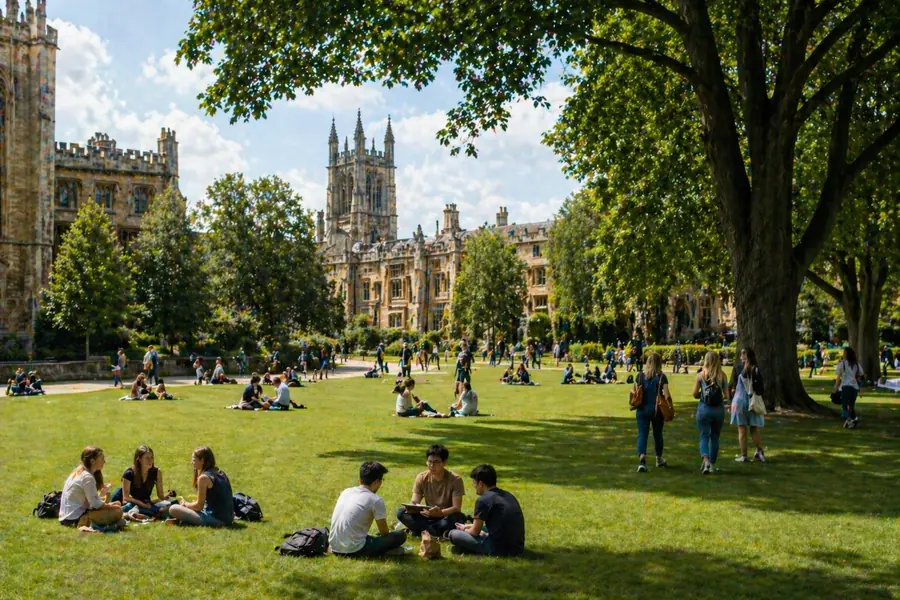
Oxford and Cambridge
Oxford and Cambridge accept the IB and make offers to IB students every year. Standard offers typically sit at 38–40 points overall, with 7,7,6 or 7,6,6 at Higher Level depending on the course. For medicine at Cambridge, the expectation is 40–42 points with 7,7,6 at HL including Chemistry and Biology. For a full breakdown of Oxford’s entry requirements, costs, and acceptance rates, see our Oxford University Admission Guide 2026.
What Oxbridge tutors care about most, though, is not the qualification itself — it is the depth of engagement with the relevant subject. This is where A-Levels have a structural advantage for highly focused applicants. A student doing A-Level Chemistry, Biology, and Mathematics has spent two years on almost nothing else. An IB student, however strong, has divided their attention across six subjects plus the core components. The breadth that makes the IB genuinely impressive is also, for Oxbridge purposes, a constraint on the depth that tutorials are designed to reward.
This does not make the IB a poor choice for Oxbridge applicants. It means IB students need to work harder to demonstrate subject-specific depth — through the Extended Essay, through Higher Level choices, and through extracurricular engagement with the subject. An IB student with a 7 in HL Chemistry and an Extended Essay in biochemistry is making a strong case. One with a 6 in HL Chemistry and an Extended Essay in economics is a harder sell for a medicine application.
Russell Group Broadly
Outside Oxford and Cambridge, Russell Group universities — UCL, Imperial, Edinburgh, Bristol, Warwick, and others — are generally comfortable with either qualification. Imperial, which sits among the most scientifically rigorous universities in the world, asks IB applicants for 39–42 points with 6s or 7s at Higher Level in relevant sciences. UCL’s requirements are similar.
For most Russell Group courses, a strong IB score is at least as competitive as strong A-Levels. In some cases — particularly for students applying from international school systems where A-Levels are not available — admissions tutors are experienced at reading IB transcripts and contextualising them accurately.
Medicine Specifically
Medicine is the course where qualification choice matters most, because the entry requirements are most specific. Almost every UK medical school requires Chemistry at a high level, and most want Biology too. For A-Level applicants, this means Chemistry plus Biology plus one further subject. For IB applicants, it means Chemistry and Biology at Higher Level — Standard Level will not satisfy most medical school requirements.
Beyond subject requirements, medicine applicants also sit the UCAT (and in some cases the BMAT, though its use has declined). Neither exam is specific to A-Levels or IB — both qualifications leave students equally prepared, or unprepared, for admissions testing. Preparation matters more than qualification choice here.
For International Students Specifically
International students applying from outside the UK are in a position that is actually more straightforward than it sometimes feels. UK admissions tutors at competitive universities are experienced at evaluating international qualifications. They know what a 42-point IB score means. They know what A*A*A at A-Level means. They are not guessing.
What international students sometimes underestimate is context. A 40-point IB score from a highly selective international school in São Paulo or Buenos Aires reads differently from a 40-point score achieved with less rigorous school support. Admissions offices use contextual data — they are aware of school performance profiles, and they factor them in. A strong score from a strong school is the clearest signal an application can send.
Academic Depth vs Academic Breadth
This is the actual tension at the centre of the A-Levels vs IB debate, and it is worth being direct about it rather than pretending both qualifications are simply different routes to the same destination.
A-Levels produce specialists. A student who has spent two years doing nothing but Chemistry, Biology, and Mathematics arrives at university having thought hard about a narrow set of ideas for a long time. They have written essays, solved problems, and sat exams in those subjects repeatedly. They know them. For courses that require immediate subject depth — medicine, engineering, mathematics — this is genuinely useful preparation.
The IB produces something different. A student who has completed the IB has engaged seriously with a language, a humanity, a science, mathematics, and an arts subject, plus written a substantial independent research paper and completed a philosophy course on the nature of knowledge. They are, in a real sense, more broadly educated. They have practiced switching between disciplines. They have had to manage a larger and more complex workload than most A-Level students face.
Neither of these is obviously superior. It depends entirely on what comes next.
For a student heading into medicine, engineering, or mathematics at a UK university, the depth of A-Levels is probably the better preparation — not because the IB is weak, but because the first year of those courses assumes and builds on subject-specific knowledge that A-Levels develop more thoroughly.
For a student heading into law, PPE, international relations, or a liberal arts programme — or one who genuinely does not yet know what they want to study — the breadth of the IB is a real advantage. It keeps options open. It develops the kind of interdisciplinary thinking that those courses reward. And it produces a more rounded applicant profile at the point of application.
The honest version of the A-Levels vs IB question is not “which is better?” It is “better for what?”
A-Levels vs IB — Key Differences At A Glance
A direct comparison of the two qualifications across the dimensions that matter most for UK university admission:
| Factor | A-Levels | IB Diploma |
|---|---|---|
| Number of subjects | 3 (occasionally 4) | 6 (3 HL, 3 SL) |
| Academic focus | Depth | Breadth |
| Duration | 2 years | 2 years |
| Compulsory core | None | TOK, Extended Essay, CAS |
| Grading | A*–E per subject | 1–7 per subject, max 45 points |
| Assessment | Primarily final exams | Exams plus internal assessment |
| Oxbridge typical offer | A*AA to A*A*A | 40–42 points, 7,7,6 at HL |
| Best suited for | Students with a clear subject focus | Students who want breadth or are undecided |
| Recognised internationally | Widely, especially in UK/Commonwealth | Globally, across 160+ countries |
| Workload style | Intensive in fewer areas | Sustained across many areas |
Which Should Your Child Choose?
There is no universally correct answer. But there are clear patterns, and most families who think carefully about this end up in one of two camps fairly quickly.
Choose A-Levels If…
Your child already knows what they want to study — or at least what area they are heading towards. Medicine, engineering, mathematics, natural sciences, economics: these are all courses where subject-specific depth matters from day one, and A-Levels build that depth more directly than the IB.
Your child performs best under focused pressure. A-Levels demand sustained, intensive engagement with a small number of subjects over two years. Students who thrive when they can go deep — who find breadth diluting rather than enriching — tend to do better in an A-Level environment.
Your child is applying primarily to UK universities and is studying in a school where A-Levels are the norm. There is no advantage to swimming against the current here. If the school’s teaching, resources, and culture are built around A-Levels, that is the environment your child will be supported in.
Your child finds exam-based assessment plays to their strengths. A-Level grades rest heavily on final exams. Students who can consolidate knowledge and perform under timed conditions tend to do well. Those who struggle with high-stakes terminal assessment face a genuine structural risk.
Choose IB If…
Your child is at an international school where the IB is the standard offering — and switching to A-Levels would mean changing schools or studying in isolation from their peers. In this case, the question is not really A-Levels vs IB. It is how to build the strongest possible IB application.
Your child is genuinely undecided about their direction. The IB keeps options open in a way A-Levels do not. A student who completes the IB with strong Higher Level results across sciences and humanities can credibly apply to medicine, law, economics, or social sciences. An A-Level student who chose the wrong three subjects at 16 has a harder problem.
Your child values — and will genuinely engage with — the broader components of the IB. The Extended Essay, Theory of Knowledge, and CAS are not box-ticking exercises for students who take them seriously. A well-executed Extended Essay in a relevant subject is a real asset in a personal statement. A student who treats these components as chores will get less out of them than one who sees them as opportunities.
Questions To Ask Before Deciding
What does my child actually want to study? If the answer is medicine, engineering, or mathematics, subject depth matters — lean towards A-Levels. If the answer is genuinely uncertain, breadth is an asset.
What does their school do well? A school with strong A-Level teaching and weak IB support, or vice versa, is telling you something important. Institutional support matters more than people admit.
How does my child handle workload and pressure? The IB is not harder than A-Levels — it is differently demanding. Six subjects plus core components requires sustained organisation across a wider front. Three subjects at A-Level requires sustained depth in a narrower one. Neither is easy. They are just hard in different ways.
How To Strengthen Either Application

Qualification choice sets the foundation. What gets built on top of it is what actually differentiates competitive applicants from the rest — particularly for medicine, business, and technology courses at selective UK universities.
The students who secure places at Oxford, Cambridge, UCL, and Imperial are not simply the ones with the best grades. At that level, grades are the entry ticket, not the deciding factor. What separates successful applicants is evidence of genuine engagement with their subject outside the classroom — clinical exposure for medicine, real business or financial analysis for economics, hands-on coding and AI literacy for computer science.
For younger students — those currently in Years 10 to 12, whether on the A-Level or IB track — the most valuable thing they can do is find structured environments where that kind of engagement is possible. Not work experience that amounts to observation, and not online courses that produce a certificate but no real intellectual challenge. Actual academic engagement, at university level, with qualified people who can assess their thinking and give them something credible to show for it.
This is precisely what Oxbridge Scholars is built around. Hosted at Queens’ College, University of Cambridge — ranked number one in the Complete University Guide 2025 — the programme runs two-week residential sessions each summer for students aged 14 to 17, across three specialist tracks: Medicine, Business & Finance, and AI & Computer Science.
Students work in small tutorial groups with senior academics from Oxford, Cambridge, UCL, and Imperial. They complete a structured industry project, produce assessed written work, and leave with a tailored letter of recommendation from a senior tutor — the kind of document that carries genuine weight in a personal statement and at interview.
Whether your child is pursuing A-Levels or the IB, the application they submit to a competitive UK university will be stronger for having done something real with their subject before they apply. Sessions for Summer 2026 are open at oxbridge-scholars.co.uk.

Frequently Asked Questions
Do UK universities prefer A-Levels over the IB?
No — at least not officially, and in practice the difference is smaller than many families assume. Both qualifications are well understood by UK admissions offices. Where A-Levels have a structural edge is for highly focused courses like medicine or engineering, where subject-specific depth matters from the first week of university. For broader courses, or for students applying from international school systems where the IB is standard, a strong IB score is fully competitive.
Can an IB student get into Oxford or Cambridge?
Yes. Both universities admit IB students every year. Oxford typically asks for 38–40 points with strong Higher Level grades in relevant subjects. Cambridge asks for 40–42 points for competitive courses including medicine. The key is Higher Level subject choice — HL Chemistry and HL Biology are non-negotiable for medicine, for example. IB students who choose their Higher Levels strategically and perform at the top of the grade distribution are competitive applicants.
Is the IB harder than A-Levels?
Different, not harder. The IB is demanding across a wider front — six subjects, plus Theory of Knowledge, an Extended Essay, and CAS. A-Levels are demanding in fewer areas but at greater depth. Students who are highly organised and comfortable switching between disciplines tend to handle the IB well. Students who prefer to go deep into a small number of subjects tend to prefer A-Levels. Neither system is objectively more difficult — they just test different things.
What IB score do I need for a UK medical school?
Most UK medical schools ask for 36–40 points overall, with Higher Level Chemistry and Biology at 6 or 7. Oxford and Cambridge sit at the top end — 40–42 points, with 7,7,6 at Higher Level. Imperial typically asks for 39–42 points with 6s or 7s in HL sciences. Standard Level Chemistry will not satisfy most medical school requirements — if medicine is the goal, Chemistry must be taken at Higher Level from the outset.
Does it matter which subjects I choose at A-Level or IB for university admission?
Significantly. Subject choice matters more than most students realise at 15 or 16, when the decision is made. For medicine: Chemistry is mandatory, Biology strongly preferred. For engineering: Mathematics and Physics are standard. For economics: Mathematics is increasingly expected, even at universities that do not formally require it. The wrong subject choices at A-Level or IB HL can close doors that are very difficult to reopen. If your child has a likely direction, research the entry requirements for their target courses before choosing subjects — not after.
How can a student strengthen their application regardless of qualification?
Grades are the entry ticket. What differentiates competitive applicants at the top universities is evidence of genuine engagement with their subject outside school — clinical exposure for medicine, real analytical work for economics, hands-on technical projects for computer science. A structured pre-university programme at a credible academic institution is one of the most effective ways to build this. Oxbridge Scholars runs two-week residential programmes at Queens’ College, Cambridge each summer for students aged 14–17 across Medicine, Business & Finance, and AI & Computer Science. Find out more at oxbridge-scholars.co.uk.
